Austin Point Was Never Really a Secret. It Just Never Had a Parking Lot.
August 13, 2026
August 13, 2026
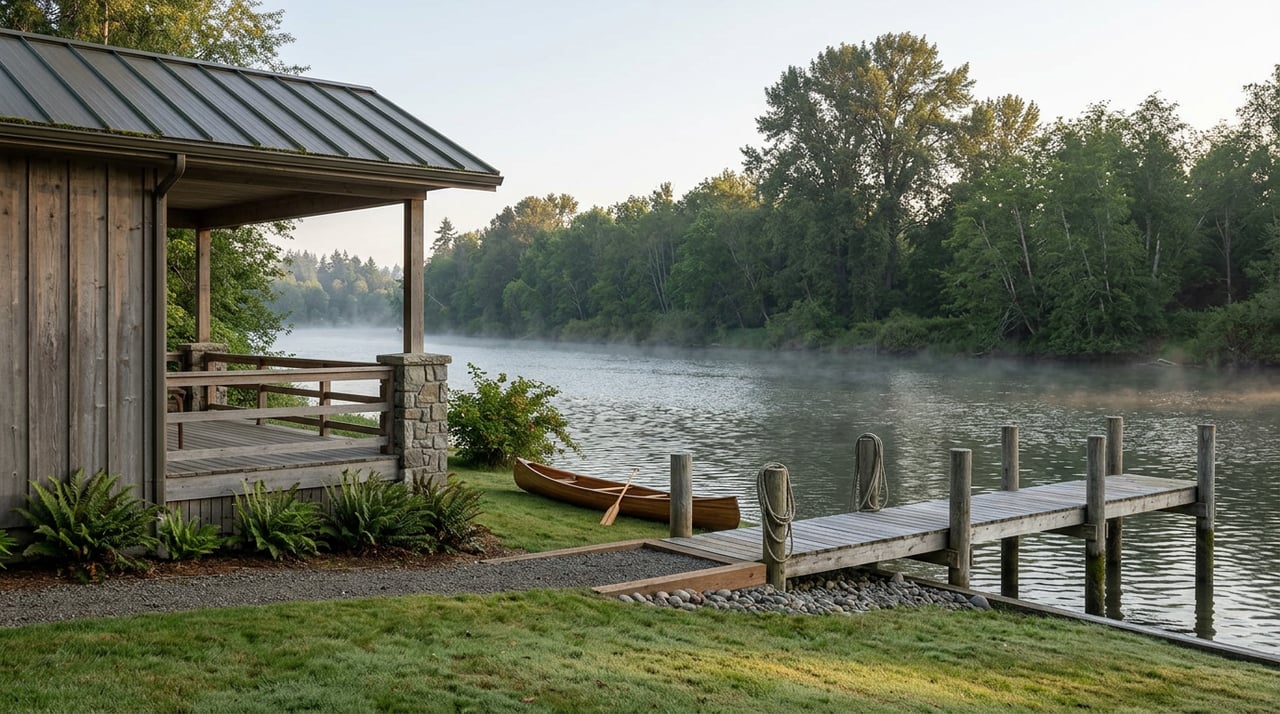
Drive out Dyke Road past the edge of town and the pavement runs out before the river does. What's left is a rutted gravel track that dead-ends at a stretch of shoreline where the Lewis River gives up its name and becomes the Columbia. There's no sign marking the spot. No restroom. No paved lot, just wherever a truck can find flat ground in the grass. And yet on any warm Saturday, you'll find coolers, folding chairs, and someone's kid wading out to check a line. Locals have been coming here for years without anyone building them a reason to.
That's Austin Point, and it belongs to the Port of Woodland. For most of its history, the Port's interest in this ground had nothing to do with picnic tables. It has eyed the site since buying the land in the early 1960s as a possible deep-water shipping terminal, the kind that could handle Panamax-sized cargo vessels. The recreation area now taking shape there isn't a new discovery. It's an old habit finally getting some infrastructure to match it.
Before any grant money showed up, Austin Point was already doing the job a park does. As The Reflector reported in August 2025, the site sits just outside city limits and has been used by locals for years despite the total absence of infrastructure, with visitors reaching it through a gravel road and parking wherever they can. The TDN's coverage of the same funding announcement put it more plainly: the site is currently used by anglers and beach-relaxers, full stop.
That's the part worth sitting with. Nobody had to advertise this place. It earned its regulars the hard way, one rutted drive at a time.
The Port of Woodland announced in late July 2025 that it had landed $1.8 million in two grants from the Washington State Recreation and Conservation Office to formalize Austin Point into a 90-acre public recreation area, as first reported by The Columbian. Port Commission President Bob Wile called it a project the Woodland community had wanted for numerous years, saying the funding finally let the Port move forward to provide a safe and clean recreational area.
The timeline behind that sentence tells you something about how these things actually move. Port Executive Director Jennifer Wray-Keene told The Reflector that the team was only just reassembling after the project had sat untouched for over a year, saying they were notified on a Friday that funding had come through and were now getting everyone back together to set milestones and figure out a groundbreaking date. In other words, as of the most recent public reporting, nobody had broken ground yet. The money existed. The construction schedule didn't, not in any fixed sense.
The improvements planned for Austin Point read less like new attractions and more like a punch list of everything the site has been missing the whole time it was already popular. Per the Port's own release, cited by TDN, the grants will fund a paved parking lot, compost restrooms, trails, fish cleaning stations, lighting, landscaping, and fencing. The Reflector's reporting adds paved access roads and a primitive boat launch, with no concrete ramp planned. Port Commissioner Rob Rich framed the goal as keeping the native feel intact, saying the site would retain its natural shore for boaters to launch from while opening up more of the area for walking, biking, boating, picnicking, and fishing along the shore.
None of that description involves inventing a new reason to visit. It's plumbing, pavement, and a place to park that doesn't turn to mud in the rain.
The Port has also said it's premature to decide whether parking fees will apply once the site is finished, though Wray-Keene told The Reflector the goal is to exempt Port District residents from any charges. As for the calendar, the Port has estimated the project will be done by 2027 or early 2028, according to The Columbian's July 2025 report, which also noted the Port was, at that point, turning its attention to finalizing engineering, starting the permitting process, and beginning cultural resources consultations. That last item isn't a formality. It's the reason this kind of project takes years instead of months.
Part of what slows a project like this down is that the confluence of the Lewis and Columbia rivers isn't just scenery. The Columbian's coverage noted that the Yakama Nation's Pacific Lamprey Project had found lamprey at the confluence the year before the grant announcement, an important native species for measuring river health. Columbia Riverkeeper, which has separately opposed the Port's industrial ambitions for the site, describes the surrounding area as habitat for sandhill cranes, salmon, steelhead, and Columbia white-tailed deer, and notes its proximity to the Ridgefield National Wildlife Refuge.
That ecological backdrop is exactly why the Port's post-funding to-do list includes cultural resource work and permitting alongside the visible construction. A parking lot is simple. Building one next to a documented lamprey habitat, without disturbing what makes the confluence worth visiting in the first place, is not.
It helps to remember that Austin Point recreation funding didn't happen because the Port decided to stop chasing industrial development there. The Port's own mission statement, posted on the City of Woodland's site, is to support job creation through economic growth and recreational opportunities together, not one instead of the other. The Port still owns more than 200 acres at Austin Point zoned for heavy industrial use, and it has pursued the idea of a deep-water marine terminal there for decades. Columbia Riverkeeper's campaign page currently lists that industrial push as on hold, not abandoned.
In the same month the recreation grants were finalized, the Port also secured a separate $752,000 grant to extend roads and utilities along Rose Way, adjacent to its industrial park, supporting private development by Trammell Crow, MMR, and Actech, who together control nearly 100 acres of industrial-zoned land nearby, per The Reflector. Wray-Keene described that investment as a way to spread the tax burden across new development and bring jobs to Woodland that don't depend on the recreation side of the ledger at all.
Put those two grants side by side and the picture is a Port running two projects on two clocks, using the same 200-acre holding to pursue both a public beach and an industrial future. The recreation money simply cleared its funding hurdle first.
If you already treat Austin Point as your spot, nothing about your access changes this week, this month, or likely this year. The gravel road is still the gravel road. The lack of a restroom is still the lack of a restroom. As of the most recent reporting, the Port hadn't set a groundbreaking date, and full build-out isn't expected until 2027 or early 2028.
What's worth knowing is that the version of Austin Point you've been using without a second thought, the one with the rutted parking and no signage, is on a countdown. The Port's stated intent to exempt Port District residents from parking fees is a small detail, but it's the kind of detail that tells you who this project is actually for. It's not a new market being carved out of the riverfront. It's an old, informal, well loved stretch of shoreline finally getting the plumbing to match how long people have already been showing up.
That's the pattern worth watching in a place like Woodland. The land underneath a place like Austin Point carries history, use, and competing plans long before any of it shows up as a headline. Understanding what a piece of ground has already been used for, and what it's still zoned to become, is the same kind of groundwork Woodland Real Estate does for property of every size across Southwest Washington, from a half-acre lot to a stretch of riverfront with more than one future in front of it. If you're trying to make sense of what's happening to land near you, or what a parcel like this means for the value or use of property nearby, Let's Connect.
We understand that buying or selling a property is more than just a transaction: it’s a life-changing experience. That’s why our team of highly seasoned real estate professionals is dedicated to providing exceptional, personalized service for all of our clients.