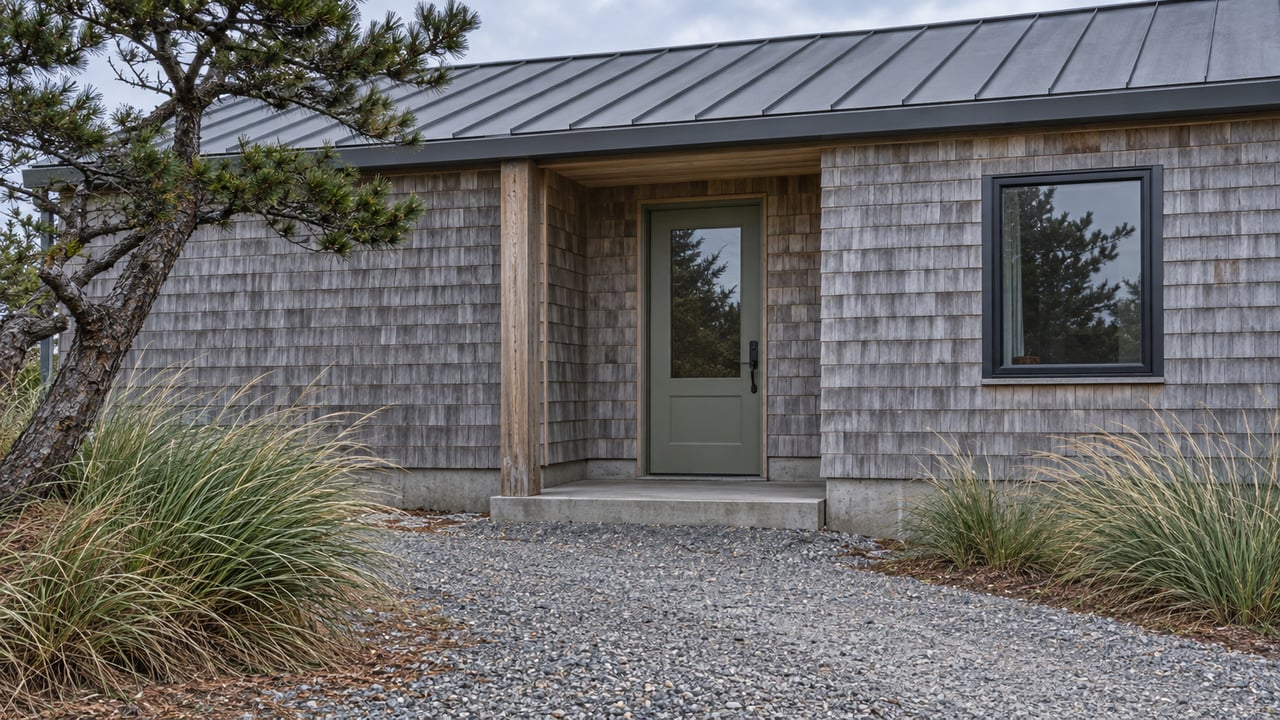
The Airbnb Income on a Long Beach Peninsula Listing Isn't Part of the Sale
October 1, 2026
October 1, 2026
Say you're touring a house near Ocean Park or Seaview, the kind of place with a rooftop deck and a listing sheet that includes a line most agents love to show off: trailing gross rental income from the last twelve months on Airbnb or Vrbo. The number is real. The seller earned it. What the sheet doesn't say is that the permit behind that number belongs to the seller, not the house, and it stops working the moment the deed changes hands.
That distinction changes the math on almost every vacation-rental listing on the Long Beach Peninsula, and it's the kind of detail that only shows up once you've read the actual ordinance rather than the marketing copy built around it.
Long Beach's municipal code is direct about this. The city's vacation rental section states that the license is non-transferable, and if the property sells, the new owner has to reapply for both the license and the underlying permit from scratch. The same section sets a waiting period on top of that: a new owner has to hold the property for a minimum of three months before they're even allowed to submit a new application.
That's not a formality. It means a buyer who closes in October can't legally advertise the unit as a short-term rental again until sometime in January at the earliest, and that's assuming the application sails through inspection on the first pass. In the meantime, the only income the property can generate is a long-term lease of 30 days or more, or nothing.
The rule exists for a reasonable purpose. Each new owner has to go through the same floor plan review, egress check, and fire and life safety inspection the previous owner went through, because the city wants current information about who's responsible for the unit, not a permit that outlived the person who was accountable for it. But reasonable doesn't mean free. For a buyer who priced the property partly on its rental history, three months of dead income is a real cost that belongs in the offer, not a surprise that shows up after closing.
Short-term rental data aggregator STRProfitMap puts median host earnings inside Long Beach city limits at roughly $38,112 a year, with an average daily rate around $254 and occupancy near 49 percent. Top performers clear closer to $59,779. Countywide, the numbers run higher, with a median around $53,340 a year and an average daily rate near $333, still at roughly the same 49 percent occupancy.
Those are the figures a seller's spec sheet is built on. Whether a buyer can reproduce them depends entirely on where the parcel sits and what zone it's in, and the answer isn't the same on every block.
Inside Long Beach city limits, vacation rentals are allowed outright in the OT, OTW, RC, AC, C1, S3, S3R, and S3M zones. They're allowed conditionally in R2R and S2. They're flatly not allowed in R1, R1R, R2, R3, R3R, C2, L1, or S1. Within the R2R and S2 zones specifically, a new vacation rental has to sit at least 200 feet from any other permitted vacation rental, measured from property line to property line, and the code is explicit that this setback can't be relaxed through a variance process under any circumstance.
| Zoning district | Vacation rental status inside city limits |
|---|---|
| OT, OTW, RC, AC, C1, S3, S3R, S3M | Allowed outright |
| R2R, S2 | Allowed conditionally, 200-ft spacing from another vacation rental |
| R1, R1R, R2, R3, R3R, C2, L1, S1 | Not allowed |
A buyer who assumes a listing's income carries over because the seller had a permit is really betting that the zone hasn't changed and that no other vacation rental has filed within that 200-foot ring since the seller last renewed.
Most of the peninsula's acreage and waterfront inventory sits in unincorporated Pacific County, where the county, not the city, issues the license and the zoning categories run on a different map entirely. The county's own vacation rental permit checklist lays out the mechanics, and the pattern is stricter, not looser.
In the county's R-1, R-2, and R-R districts, a vacation rental has to sit at least 500 feet from any other dwelling operating as a vacation rental, measured building to building, more than double the city's 200-foot standard. And on every parcel, whether inside city limits or out, only one dwelling can carry the license. If a property has a main house and an accessory dwelling and the seller was renting both, the buyer inherits the right to license exactly one of them, not two.
The fees track the zoning too. A parcel that falls into a Permitted Use category runs about $975 in total license fees, covering the application, technology, zoning review, and license itself. A parcel in a Special Use category runs about $2,175 for the same package, plus a Hearings Examiner fee billed separately by the county's Department of Community Development, and that fee varies by case rather than sitting at a flat rate.
This is the layer that turns a listing's trailing income into a question rather than a guarantee. A parcel's zoning designation, not its street address or its current photos, decides whether a new license is even possible, and a buyer who skips that check is pricing the house on a number the county might not let them keep.
A few questions answer most of the uncertainty before an offer goes in:
None of this makes vacation-rental ownership on the peninsula a bad idea. It makes it a due-diligence problem with a specific, answerable set of steps, the same way confirming a well's yield or a septic system's capacity is a due-diligence problem on a rural acreage purchase inland.
Pacific County's overall home values give buyers some breathing room to run these checks properly instead of racing a closing date. Zillow's tracking put the county's average home value at $334,110 as of August 31, 2026, down 0.7 percent over the previous year, with homes moving to pending status in around 55 days. That's a slower pace than a hot suburban market, and it means a buyer asking for extra time to confirm zoning, measure distance to the nearest permitted rental, and verify a license number with the county isn't fighting a bidding war to get it.
A due-diligence period built around those specific questions costs a seller very little and protects a buyer from paying for income that legally can't follow them home.
If you're weighing a vacation-rental purchase on the Long Beach Peninsula or anywhere else in Pacific County and want someone to check the zoning, the spacing, and the permit status on a specific parcel before you write an offer, June Jones is glad to walk through it with you. Let's Connect.
We understand that buying or selling a property is more than just a transaction: it’s a life-changing experience. That’s why our team of highly seasoned real estate professionals is dedicated to providing exceptional, personalized service for all of our clients.